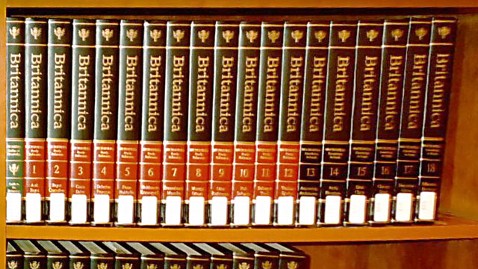
 The Encyclopedia Britannica will no longer be printed. The last edition published was in 2010 of which 4000 copies remain to be sold. They retail for $1400 per set.
As a kid Encyclopedia Britannica was my favorite encyclopedia because it was the most comprehensive and least watered down compared to all others. But ever since Wikipedia was born (and to some extent Google), the encyclopedia has been losing its share of the market. $1400 is not pocket change and as an adult knowledge worker, the ability to contribute to Wikipedia and to keep it current provides some measure of pleasure that a printed encyclopedia could not possibly provide. Though I still think there is a market for privately published encyclopedias: they are able to maintain a more consistent language suitable for children and young adults than Wikipedia.
The Encyclopedia Britannica will no longer be printed. The last edition published was in 2010 of which 4000 copies remain to be sold. They retail for $1400 per set.
As a kid Encyclopedia Britannica was my favorite encyclopedia because it was the most comprehensive and least watered down compared to all others. But ever since Wikipedia was born (and to some extent Google), the encyclopedia has been losing its share of the market. $1400 is not pocket change and as an adult knowledge worker, the ability to contribute to Wikipedia and to keep it current provides some measure of pleasure that a printed encyclopedia could not possibly provide. Though I still think there is a market for privately published encyclopedias: they are able to maintain a more consistent language suitable for children and young adults than Wikipedia.
Wednesday, March 14, 2012
Encyclopedia Britannica: last printing
The Encyclopedia Britannica will no longer be printed. The last edition published was in 2010 of which 4000 copies remain to be sold. They retail for $1400 per set.
As a kid Encyclopedia Britannica was my favorite encyclopedia because it was the most comprehensive and least watered down compared to all others. But ever since Wikipedia was born (and to some extent Google), the encyclopedia has been losing its share of the market. $1400 is not pocket change and as an adult knowledge worker, the ability to contribute to Wikipedia and to keep it current provides some measure of pleasure that a printed encyclopedia could not possibly provide. Though I still think there is a market for privately published encyclopedias: they are able to maintain a more consistent language suitable for children and young adults than Wikipedia.

Saturday, March 3, 2012
Wagner's Götterdämmerung Review
 I saw the HD Live performance on Feb 11 at a theatre. I hesitated going because I was so disappointed in the Brunnhilde of the prior opera Siegfried, but I felt I had to see the last installment of the Ring. And I'm glad I did.
 Brunnhilde (Deborah Voigt)
Siegfried (Jay Hunter Morris). Voigt had some serious issues in the prior opera Siegfried. The singing was simply awful. However, she redeemed herself in Götterdämmerung. The love duet in Act 1 between Siegfried and Brunnhilde was ok. It did sound like Voigt was in reach of the high C. What I didn't like was the stage direction. Brunnhilde came out swinging the sword Nothung when in Wagner's direction, it is Siegfried who should be fully armed. If the director wanted Brunnhilde to come out with Nothung, he should have her admiring the sword forged by her father Wotan, found by Siegmund whom she attempted to rescue, and reforged by Siegfried who awakened her. Instead she is just playing around with it like a child. Over all, the scene was more playful than I had wanted; both singers were too fidgety. After their intimate encounter, they should both be engulfed in a peaceful afterglow; not act as if they had just gulped several shots of expressos. In contrast to the love scene, the acting in the abduction scene was exciting. Voigt really was struggling with Morris, and Morris really seemed possessed and terrifying.
Act 2 was where Voigt totally knocked it out of the ball park. Her acting and singing was a huge delight. Her voice is well suited to fury. I was so happy with Act 2 that I started to clap before the curtains fell. Morris's singing and acting was good as well.
In Act 3, Morris delivers a charming Siegfried when he runs into the Rhinemaidens. And even when found by Hagen's party, he seemed totally unaware of his fate. Great acting. I like Morris but when he is paired with Voigt, his voice seems somewhat small. Voigt's finale segment was fine but didn't have warmth and she started to cast doubt on her own singing.
Brunnhilde (Deborah Voigt)
Siegfried (Jay Hunter Morris). Voigt had some serious issues in the prior opera Siegfried. The singing was simply awful. However, she redeemed herself in Götterdämmerung. The love duet in Act 1 between Siegfried and Brunnhilde was ok. It did sound like Voigt was in reach of the high C. What I didn't like was the stage direction. Brunnhilde came out swinging the sword Nothung when in Wagner's direction, it is Siegfried who should be fully armed. If the director wanted Brunnhilde to come out with Nothung, he should have her admiring the sword forged by her father Wotan, found by Siegmund whom she attempted to rescue, and reforged by Siegfried who awakened her. Instead she is just playing around with it like a child. Over all, the scene was more playful than I had wanted; both singers were too fidgety. After their intimate encounter, they should both be engulfed in a peaceful afterglow; not act as if they had just gulped several shots of expressos. In contrast to the love scene, the acting in the abduction scene was exciting. Voigt really was struggling with Morris, and Morris really seemed possessed and terrifying.
Act 2 was where Voigt totally knocked it out of the ball park. Her acting and singing was a huge delight. Her voice is well suited to fury. I was so happy with Act 2 that I started to clap before the curtains fell. Morris's singing and acting was good as well.
In Act 3, Morris delivers a charming Siegfried when he runs into the Rhinemaidens. And even when found by Hagen's party, he seemed totally unaware of his fate. Great acting. I like Morris but when he is paired with Voigt, his voice seems somewhat small. Voigt's finale segment was fine but didn't have warmth and she started to cast doubt on her own singing.
 Alberich (Eric Owens),
Hagen (Hans-Peter König): König sung and acted well. However he did not sound evil or menacing enough. He pretty much was similar to Hundig from Das Rheingold. The best scene probably was the sleep sequence in Act 1 when his father Alberich appears to him. Owens delivers an Alberich who is in his own twilight. Although I've read that they have big voices, I was not at the MET so this advantage disappears.
Alberich (Eric Owens),
Hagen (Hans-Peter König): König sung and acted well. However he did not sound evil or menacing enough. He pretty much was similar to Hundig from Das Rheingold. The best scene probably was the sleep sequence in Act 1 when his father Alberich appears to him. Owens delivers an Alberich who is in his own twilight. Although I've read that they have big voices, I was not at the MET so this advantage disappears.

 Gunther (Iain Paterson), Gutrune (Wendy Byrn Harmer): The Gibichung brother and sister pair. Paterson did a good job though it was a bit straightforward. If Gunther was portrayed as more indecisive, then the ending would have fit a little better. Harmer did a wonderful job as Gutrune. I absolutely loved her screams (I wish Sieglinde had screamed in Walküre and Fafner had roared in Siegfried). During the intermission she had mentioned that she had been singing Wagner since age 25 (or 27?) and that she hoped to one day sing Sieglinde. I completely endorse her as Sieglinde. She has stage presence and a strong voice; she stood out as Freia in Das Rheingold and as a Valkyrie in Die Walküre.
 Waltraute (Waltraud Meier) |
 Norns (Maria Radner (I), Elizabeth Bishop (II), Heidi Melton (III)) |
 Rhine maidens: Woglinde, Wellgunde, Flosshilde
(Erin Morley, Jennifer Johnson Cano, Tamara Mumford) |
 The men from the Metropolitan Opera chorus took the part of Gibichung vassals and did a great job.
Concerning the costumes, they were alright. I understand they wanted the human costumes to look mostly like peasantware. The exotic costumes were saved for the Norns, the Rhine maidens, and Waltraute. The only costume that felt underdone was Alberich's; his clothing should have looked more disheveled and less human.
The staging was actually traditional. If you look at these drawings by early 20-th century artist, Arthur Rackham, you will recognize them in this production of the Ring. Honestly, those artistic people couldn't be more original for their production?
The men from the Metropolitan Opera chorus took the part of Gibichung vassals and did a great job.
Concerning the costumes, they were alright. I understand they wanted the human costumes to look mostly like peasantware. The exotic costumes were saved for the Norns, the Rhine maidens, and Waltraute. The only costume that felt underdone was Alberich's; his clothing should have looked more disheveled and less human.
The staging was actually traditional. If you look at these drawings by early 20-th century artist, Arthur Rackham, you will recognize them in this production of the Ring. Honestly, those artistic people couldn't be more original for their production?

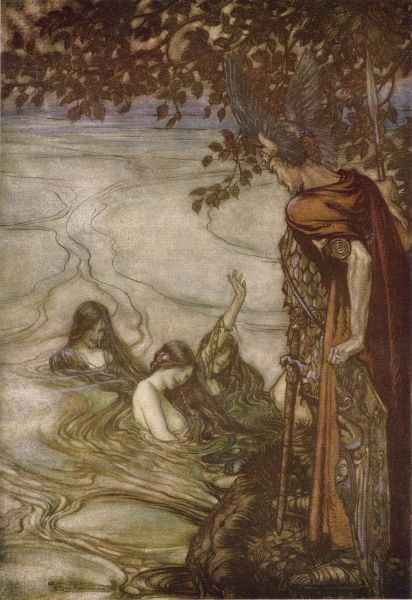
 Brunnhilde in this production has her arms out almost exactly as this drawing!
I think the most successful scene setup were the Norns', Siegfried's journey on the Rhine, the Gibichung hall (I actually liked the circular patterns), and the Gibichung hall after Siegfried's death (it really gave the impression of evening). I was disappointed in the cliffside where Siegfried and Brunnhilde emerged because it was too dark. I wanted glorious sunshine not dark skies. The scenes depicted during the orchestral transitions were dreadfully dull and repetitive. The same dark palettes and patterns were used over and over again; rather annoying. I also found the post-immolation scene was quite a let down as well. Basically, BBQ pit fire is projected on the platforms, the statues of the gods are shown crumbling lamely, and finally the platforms start undulating like the Rhine with the background lit dark blue. Couldn't the MET bring back the gods from Das Rheingold and have them appear lifeless instead? Also the overused dark blue background didn't make much sense to me; it should have been yellow or red or white to represent the love of Siegfried and Brunnhilde. Should have been a new beginning rather than twilight imho.
Overall I was pleased with the performance. But in Götterdämmerung, the mechanical platform gave very little bang for the buck.
[Photo sources: Arthur Rackham illustrations (Wikipedia entry on Gotterdammerung), Norns (LA Splash), the vassals (Likely Impossibilities Blog), title photo (Chicago on the Aisle), all other photos Minnesota Public Radio]
Brunnhilde in this production has her arms out almost exactly as this drawing!
I think the most successful scene setup were the Norns', Siegfried's journey on the Rhine, the Gibichung hall (I actually liked the circular patterns), and the Gibichung hall after Siegfried's death (it really gave the impression of evening). I was disappointed in the cliffside where Siegfried and Brunnhilde emerged because it was too dark. I wanted glorious sunshine not dark skies. The scenes depicted during the orchestral transitions were dreadfully dull and repetitive. The same dark palettes and patterns were used over and over again; rather annoying. I also found the post-immolation scene was quite a let down as well. Basically, BBQ pit fire is projected on the platforms, the statues of the gods are shown crumbling lamely, and finally the platforms start undulating like the Rhine with the background lit dark blue. Couldn't the MET bring back the gods from Das Rheingold and have them appear lifeless instead? Also the overused dark blue background didn't make much sense to me; it should have been yellow or red or white to represent the love of Siegfried and Brunnhilde. Should have been a new beginning rather than twilight imho.
Overall I was pleased with the performance. But in Götterdämmerung, the mechanical platform gave very little bang for the buck.
[Photo sources: Arthur Rackham illustrations (Wikipedia entry on Gotterdammerung), Norns (LA Splash), the vassals (Likely Impossibilities Blog), title photo (Chicago on the Aisle), all other photos Minnesota Public Radio]
Thursday, March 1, 2012
Davie Jones from the Monkees has passed
Subscribe to:
Comments (Atom)